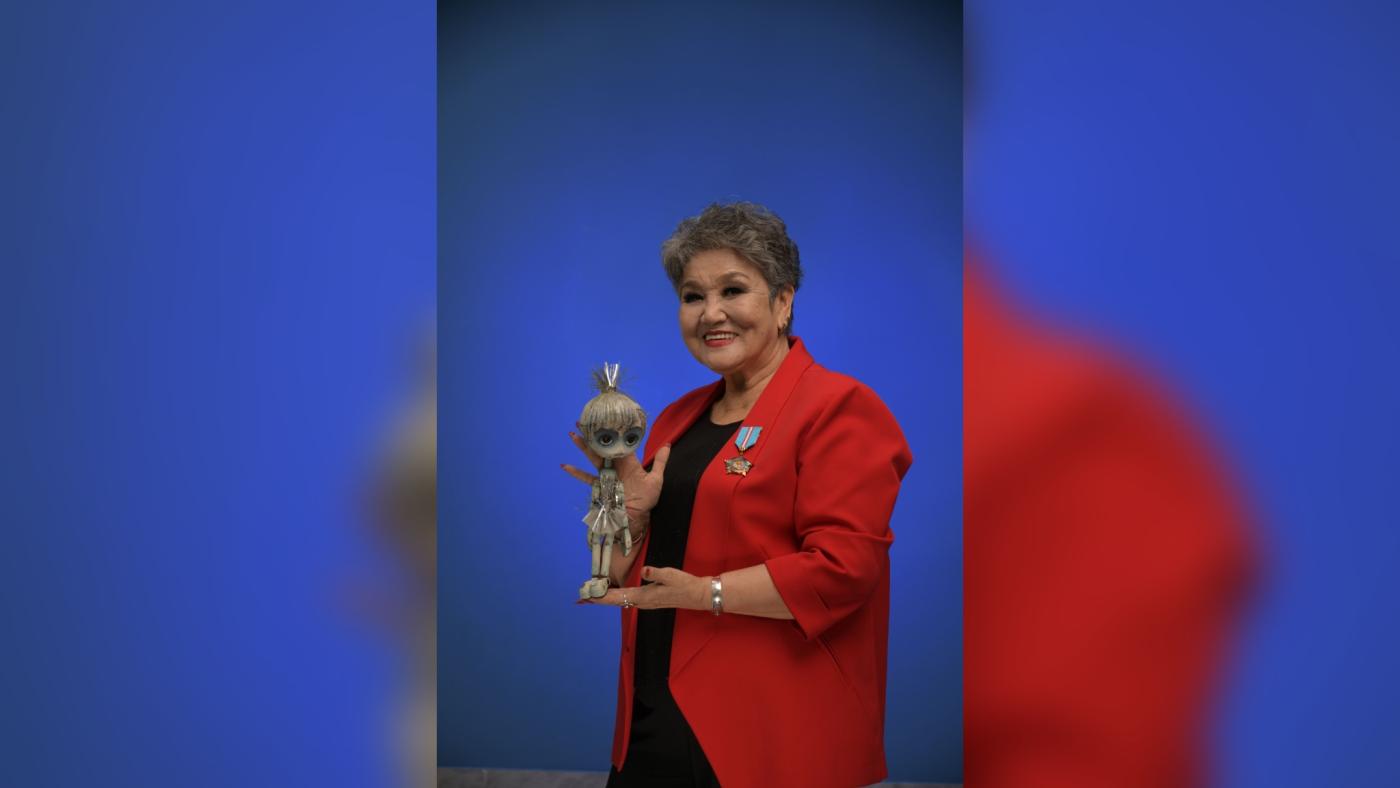
Puppet theater is not just a world of characters — it is a unique space where time and art intersect. On this stage, it takes great effort and sincere love to reach the audience’s heart. Today’s guest is a prominent representative of Kazakh puppet theater, an Honored Artist of the Kazakh SSR — Sabila Abueva, who has devoted her conscious life to this distinctive art. Her life journey is not just one person’s story, but a reflection of an entire theater’s history.
— Sabila Mendigaliyevna, your creative path began in 1967, and just two years later your судьба became closely tied to puppet theater. How has the theater changed over these many years? What has driven you to remain devoted to one stage for so long?
— My artistic journey began at the Makhambet Utemisov Theater. At that time, I was still in school and danced in a song and dance ensemble. During that period, our teacher and director Zaure Yesbergenova invited me to take part in a children’s performance. I agreed and stepped onto the stage. The warm reception and support from the audience left a deep impression on me and awakened my interest in the arts. From that moment on, the stage began to draw me in.
Later, on the advice of my friends, I came to Almaty. While walking around the city, I saw a sign that read “Puppet Theater” near Panfilov Park. I went inside and decided to try my luck. I met the theater director, Zulkari Beisetov, and demonstrated my abilities. He told me to come back the next day. That’s how I was accepted into the puppet-making workshop.
For a year, I worked in that workshop, learning everything from how puppets are made to the process of bringing them “to life.” My mentors, Evgeny Ivanov and Galina Galota, taught me a great deal. They shaped not only my technical skills but also my outlook on the stage.
Later, I began performing on stage alongside experienced actors. At first, I felt fear and uncertainty. But with the support and guidance of senior colleagues, I gradually improved. Each performance became a new lesson for me. In this way, a genuine love for the art kept me on stage. It became not just a profession, but the meaning of my life.
— It is known that your repertoire includes more than a hundred roles. Among them, your performance of two contrasting characters — the White Bird and the Witch — in Nurlan Orazalin’s play “Ak Kus” is particularly notable. How difficult was it to perform such roles simultaneously?
— Yes, in that performance I portrayed two completely opposite characters. One was the kind and gentle White Bird, and the other a cunning and malicious witch. Since their natures were so different, they required not only distinct physical movements but also entirely different inner states. I had to develop two different voices, two intonations, and two personalities.
The most difficult part was switching between these two characters instantly. Sometimes on stage, you have to run and quickly transform from one character into another. It’s not just a physical shift but also a rapid change in mindset and emotion. To make each transition convincing, it requires deep internal preparation and full dedication. But these challenges are also a great school for an actor, a valuable experience. With this performance, we even toured Vietnam. The reception from foreign audiences once again proved how universal art can be. After that tour, my work was recognized, and I received professional acknowledgment and honors. So this project was not only challenging but also a joyful and important stage of my artistic growth.
— In the performance “Puppet Festival,” you portrayed great artists like Roza Baglanova and Michael Jackson through puppets. How challenging is it to convey such personalities?
— This performance, which has become a hallmark of puppet theater, was staged by director Sultangali Shukirov. For me, it was not only an acting experience but also a major school of responsibility in puppetry. Managing two tasks at once required both stage mastery and inner harmony.
During the performance, three people operated a single puppet. This is a very delicate and complex process because even a small mistake by one person can affect the integrity of the entire character. Every movement must be anticipated, and complete synchronization is essential. Silent understanding between partners and working in one rhythm is a true mark of professionalism.
When portraying Michael Jackson, the three of us had to feel and act as one person to accurately convey his movements. His plasticity, sense of rhythm, and stage energy could only be expressed through perfect coordination. It was not just technical work, but a deep internal connection. The same applied when portraying Roza Baglanova. While one colleague controlled the puppet’s body, I managed the hands. To achieve natural and precise movement, mutual understanding was crucial. Only through this harmony were we able to present a believable and authentic image to the audience.
— You are a great mentor for today’s young actors. What would you like to say to young people who want to dedicate their lives to this art?
— Part of my happiest moments were spent with my family, and another part on stage. To live alongside art, to perform in each new production, to feel the audience’s sincere appreciation, and to see the results of your work — these are among the greatest joys for me. The respect and warmth from young people especially touch me. It means that your work continues, that the next generation accepts it and develops it further. For an artist, that is the highest recognition.
I learned a lot from my mentors. From my first steps on stage, their advice shaped and guided me. Passing on what I have learned to younger colleagues feels like a duty. Art is not only for oneself; it is a spiritual legacy for future generations. Puppet theater has a special quality — it captivates a person. If someone comes with sincerity and pure intention, the stage will hold them. It is not just a workplace; it is a sacred space where spirit and emotion meet.
Every time I step onto the stage, I say a prayer and enter with “Bismillah.” It gives me calmness and confidence. Before performing, I always gather my thoughts and approach the art with respect. The stage is a living world; it does not tolerate falsehood. Every step and movement must be genuine.
My advice to young people is to remain devoted to this art. If one enters with sincerity, the stage itself will teach, shape, and guide them. The most important things are not to avoid hard work, never tire of learning, and to come to art with your heart. Only then will this path lead a person to great heights.
Abdinagi Alma
2nd-year student, “Film and Television Dramaturgy”
Temirbek Zhurgenov Kazakh National Academy of Arts